Five for Friday: August Who? and Teacher Toolbox Woo!

Hello, Friends!

I'm back for my second Five for Friday post, and I must say I'm loving blogging. As someone who's always enjoyed writing, it's incredibly soothing to put your words on paper/the internet, but it's also very exciting to share ideas in a way that has been so helpful to me in the past. I would venture that I've learned just as many best practices from reading blogs as I have in internships or in grad school, and that's really saying something! There are so many amazing teachers out there, and I just hope to add resources to the pool of already existing incredible ideas. That said...


I've seen them, I've coveted them...and now I have one! I finally made my own teacher toolbox, and I couldn't be more excited. In conjunction with having a teacher toolbox, I've decided to get rid of my desk, which I'll share more about as it happens. However, I'm currently just thrilled that I will no longer have a scary mess inside my desk drawers. Neatly labeled, easy to access, and best of all, colorful and cute! I used wood grain papers from the fantastic Krista Wallden, along with a cute frame of hers; the font is a Cara Carroll font that I just purchased during the TPT sale, and I couldn't be more thrilled. You can find this freebie HERE, and you can find the toolbox itself HERE at Home Depot. The drawers open differently than some of the other teacher toolboxes I've seen, but I actually like it a lot; the drawers are roomy and also slide in and out pretty easily. I was thrilled to find one that was already black, though I did need to color in the little Husky logo in the corner; I may use my Cameo to put my name in that spot later...once I learn how to use it! :)


I don't do selfies, but I had to take one on my first day wearing this shirt! I saw teachers with it on at the SDE Vegas conferences and loved it...but by the time I got to the booth selling them, there were none in my size! Luckily, on the last day of the conference, I was walking through and checking one last time, and the nice man at the booth offered to MAKE me one in a shirt my size! Now, it's not the pretty teal color that some of the others were, but I do love gray, and it's so soft. Most of all, I love the message: Today I choose joy. Because we do. 


Remember the time I went to Target and all I got for school were these pencils? Because I do. Granted, I went to Michaels and Home Depot and bought ONLY school-related items, but just 1 at Target? That NEVER happens.


Alex and Ani. *swoon* I've been building my collection for years, and have a special place in my heart for them because of our shared Rhode Island roots! I received a bracelet and a gift card from a parent, and turned both into this beauty, which I LOVE. The gold, the seahorse, the colors...sigh.


I feel very lucky to have rung in August with TWO rounds of golf thus far! I played with my mom, aunt, and uncle in Jamestown, RI yesterday, and enjoyed a round with Mr. Cronin this morning up in Holden, ME! That said, he's currently waiting for me lakeside to go for a kayak/swim, and patience isn't his strong suit when the weather's nice at the lake. :)

Have a wonderful weekend, all!

- Lisa


Signature

Small Group Instruction Series: Daily 5

Hello Friends!

Today I wanted to pick up where I left off with small-group instruction in my classroom. It's a topic that is near and dear to my heart, and it's a song I'm singing in my district right now. Kiddos learn best in small groups, teachers teach best in small groups, and independence and engagement abound when kids are learning in small group...so it's a win-win-win! Today I want to share how we run Daily 5 in my room.

The Basics

For those of you who are not familiar with Daily 5, it's a system in which students learn to work independently and productively at rigorous literacy tasks. You need to read the book, for sure--there's so much valuable information in there! But, this post will give a very basic overview.


Depending on the classroom:
  • Students have a certain amount of choice in the tasks they engage in. Choice is important because it breeds engagement!
  • Rotations last a certain amount of time (about 15 minutes for me); after each, students clean up and move to the next choice.
  • Structure includes mini-lessons and rotations.

While students are working INDEPENDENTLY on their literacy tasks, teachers are running reading groups. This past year, I had 5-7 groups at any given time, which were created by reading level or a targeted skill. We usually had 2 groups running simultaneously; we saw our neediest groups daily, and others 2-4 times per week based on need (I say we because my coteacher was generally in my room during this time and ran reading groups simultaneously).

Everyone handles this part of Daily 5 a little differently, but personally I like to know that students are getting to their literacy tasks a certain number of times per week while still offering some choice. For example, Read to Self is super important to me, so in their independent work time, my students will always have the highest number of Read to Self slots to fill. Their weekly schedules look like this:


A bit about this schedule. First, the little deer clipart signals that this is a schedule for members of my Deer reading group. Their Teacher Time sessions have already been added onto the schedule for them. From there, I've dictated at the top of the schedule how many of each task they now need to fill in on the schedule. At the bottom of each day, there's a spot for students to reflect on and rate their performance that day (how hard they worked, how focused they were). Depending on which group students are in, the number of times they need to complete a task will vary based on the number of Teacher Times that group has.

The Tasks

Read to Self

  • Students read “Good Fit” books from their book bins independently (Good Fit means that the books are at that student's reading level; there is an entire lesson at the beginning of the year to teach students what that means)
  • There are 3 ways to read a book: read the pictures, read the words, retell the story (again, this is taught and modeled at the beginning of the year)
  • Sit in a good spot for them (bean bag, table spot, on rug, teacher chair, cushion, etc.)
This is from the beginning of the year when we were first learning Read to Self. Students are reading on the rug, in their chairs, on a cushion, and in a teacher chair.

Work on Writing

  • Students write independently 
  • May work on something from Writer’s Workshop, journal writing, etc.—you pick! I will either make this solely a journal writing time this year, or remove it from Daily 5 time in favor of a longer writing block.
  • Sit in a good spot for them (rainbow table, privacy desk, on rug with lap desk, etc.) 
  • Need to know where resources are (more paper, spelling resources, prompts, etc.)
These friends are working in writing journals from Sunny Days in Second Grade at one of our rainbow tables.

Read to Someone

  • Students take turns reading with a partner and checking for understanding; I plan to make a new resource that builds on the "check for understanding" concept and broadens students' conversations about what they're reading. I promise to share it soon!
    Sit EEKK (elbow to elbow, knee to knee), read from same or different books 
  • Sit in a good spot for them (usually rug or cozy stools) 
  • Find partners by raising a hand and asking the FIRST person they meet


 Work Work

  • Students practice spelling words (I have a weekly word list based on the phonics skills we're tackling that week); can be independent or partnered 
  • Tasks are basic but fun: magnetic letters, Wikki Stix, Scrabble tile spelling, Write It! 
  • Sit in a good spot for them (rug or table) 
  • Can be tracked with a bingo board or checklist


These students are doing Sign Language Spelling from 3rd Grade Thoughts.

Listen to Reading

  • Students listen to recorded stories on iPad and follow along with the text 
  • Can be independent or multi-person (headphone splitter or rockstar) 
  • Scholastic is a great way to build your collection! I order the monthly listening library sets when they're available and built my collection over time. You can also record yourself reading books you already have!
  • Can be eliminated/replaced in upper grades

Next Steps

It takes time for students to learn how to do each of these tasks independently and responsibly, so a good chunk of time is spent at the beginning of the year teaching that. Once you're ready to put it all together, your literacy block could look like any of the scenarios below, or something else you create entirely!

My schedule this year will likely look Schedule 2, but I've used a version similar to each of these in the past!

Making Reading Groups

Fall/Mid-Year: Use your DRA data, or whichever reading assessment your district uses! I find that groups tend to be level-based earlier in the year, and skill-based later in the year. I try to switch them up frequently; this could mean every 2-5 weeks, depending.

Other Times: I use post-its from 3rd Grade Thoughts to record reading conferences with students or running records and keep them in a file folder in that child's reading group basket. That way I can easily add a post-it or two to student folders any time I'm running a reading group. These are a great formative assessment that can be used to regroup students by reading level or skill.

The pink thing is half a sheet of cardstock that also lives in each reading group's basket; it helps me and my coteacher track what we did with each reading group and any notes we want to track.
Remember: Fair doesn’t mean equal! I don’t meet with each group the same amount because their needs are not the same. Some groups have Teacher Time twice, Read to Self, Work on Writing, and Read to Someone 3 times, and Listen to Reading and Word Work twice. Others have Teacher Time 5 times and all literacy tasks twice. It totally depends on the kids!

Differentiation

This format gives you so many opportunities to differentiate! Beyond reading groups, students can have personalized word lists, book bins filled with good-fit books, and the freedom to work at their own pace.

Additionally, if you have extra teachers in your room, they can be put to great use here! Special Education teachers, Title I teachers or paraprofessionals can run additional reading groups, phonics intervention, shadow a student, or float to help where needed. 
Book Bins are one of the most important ways to differentiate in Daily 5. I assign books in Teacher Time and offer additional good-fit books from the book room then. However, students choosing their own books is also crucial! I used morning work and Ketchup & Pickle as times when students could change out books in the classroom library.

Technology


Listen to Reading and/or Read to Self are opportunities to integrate technology into Daily 5 time. I have monthly Listen to Reading lists on my computer; it only takes a few minutes to update each iPad and change out the books. Another way to do Listen to Reading (or Read to Self) would be to use RazKids or another reading app.

Classroom Management


This all sounds great in theory, but how and why do kids stay on task in this format?

That’s where clear, taught, and enforced expectations come into play. First up, voice level. Students need to understand the voice levels permitted in the classroom from the get-go, and when creating your charts, you’ll need to teach those expectations.

I recommend reading Boushey and Moser’s book, because they do a beautiful job of teaching the gradual release of responsibility.

For each task, they recommend:
  • Making an I-chart
  • Modeling positive/negative/positive
  • Building stamina (starting at 1 minute!)
It takes patience and time to set up this structure, but it is worth it. I usually take the entire month of September to build up to actually trying Daily 5 for the first time. Don’t rush it! Using this process makes expectations known, clear, and ingrained, and I find that I have very few behavior problems, especially because students are engaged!

We add gestures to go along with each item on our charts! This helps to memorize them and give silent reminders to students when they get off task.

I hope this has given you a little clarity on how I run Daily 5 and reading group instruction in my classroom! Please feel free to leave questions in the comments, or share your own experiences!

Happy Teaching!
- Lisa



Signature

My Favorite STEM Materials

Happy Monday!

I am trying to cherish each of these days right now--I know summer is ending soon. Our first day back as a faculty is August 29, and our first day is August 31. Not sure what my plan is for getting into my classroom and getting set up yet. I tend to enjoy getting in early and giving myself a couple weeks out of the room right before school begins, so I suppose if that's my plan I need to check in with our custodian to see if my room is done being cleaned!

Anyways, the reason I'm writing today is to share a very favorite, very fun, very SIMPLE set of materials you can use for a whole host of STEM challenges at a variety of grade levels--honestly, for grades K-4. Maybe even more than that. Crazy, I know!

Supplies

For starters, you need wooden blocks; the more, the merrier! I find that a variety of sizes is helpful. Sometimes you need large blocks to build up your structure, but small blocks are crucial for tight places and small tweaks! I asked for mine as a holiday gift for the classroom from my families last year in lieu of a gift for me; I received two sets, and could potentially have use for a third! I'll see how it goes this year, but I do sometimes borrow blocks from the Kindergartens in a pinch.

https://www.amazon.com/Melissa-Doug-60-Piece-Standard-Blocks/dp/B00008W72D/ref=sr_1_1?ie=UTF8&qid=1470091693&sr=8-1&keywords=melissa+and+doug+wooden+blocks


Next up is hopefully a simple one: marbles! I had a set with both shooters and smaller marbles that I've had since I was a kid; having a variety of sizes is an AWESOME way to add an extra degree of difficulty when students need an extension because they've had success with the challenge. I also ordered the set below before I found my childhood collection, and was very happy with the quantity, variety, and price!

https://www.amazon.com/dp/B003BL6SZG/ref=sr_ph_1?ie=UTF8&qid=1470092155&sr=sr-1&keywords=marbles

Last but not least, you'll need cove molding. This is wooden molding--the kind you usually affix to your doors, walls, or ceilings! This particular molding is a perfect track for marbles: it's flat on the back, has a perfect, even cove that acts like a track, is relatively inexpensive, and can be cut into different lengths. Best of all, it's pretty readily available and easy to find! I've found it at various different home improvement stores.

http://www.homedepot.com/p/Alexandria-Moulding-WM-85-9-16-in-x-1-3-4-in-x-96-in-Pine-Cove-Moulding-0W085-20096C/205902092

It's difficult to say how many pieces of this you'll need. For my class of 24 last year, I purchased eighteen 1' pieces, twelve 2' pieces, and six 3' pieces. I may end up supplementing with more 1' and 2' pieces this year, but since I usually have students work in 6 groups of 4 students, I made my numbers divisible by 6. This is totally up to you!

What In the World Do I Do With It?

Make ramps and pathways, of course! If you're teaching K or 1, you might begin really simply, with figuring out how to make a marble move down a ramp. You might then move to having students get the marble to roll a certain distance, or having students compare distances the marble rolls on different surfaces, or determining whether different size marbles roll different distances on the same ramp--the possibilities are endless! In each of these experiments is the possibility to discuss the properties of motion, friction, force, gravity, variables, the scientific method...the list goes on. Rich content with very little prep!

If you're teaching 2-4, (or have K-1 students who are now familiar with these materials), you can have students use a specific set of materials (dictating number/size of blocks, number/size of ramps), have students connect more than one section of ramp, have students add a turn or a jump/chasm to their structure, layer ramps vertically, create a structure within a taped off area...again, so many possibilities! I do tend to have my students land their marble in a paper bag to avoid marbles flying everywhere, but again, you can also play with distance/friction as well. Students very quickly start understanding Newton's laws of motion without having any idea what high-level concepts they're accessing.

Show Me!

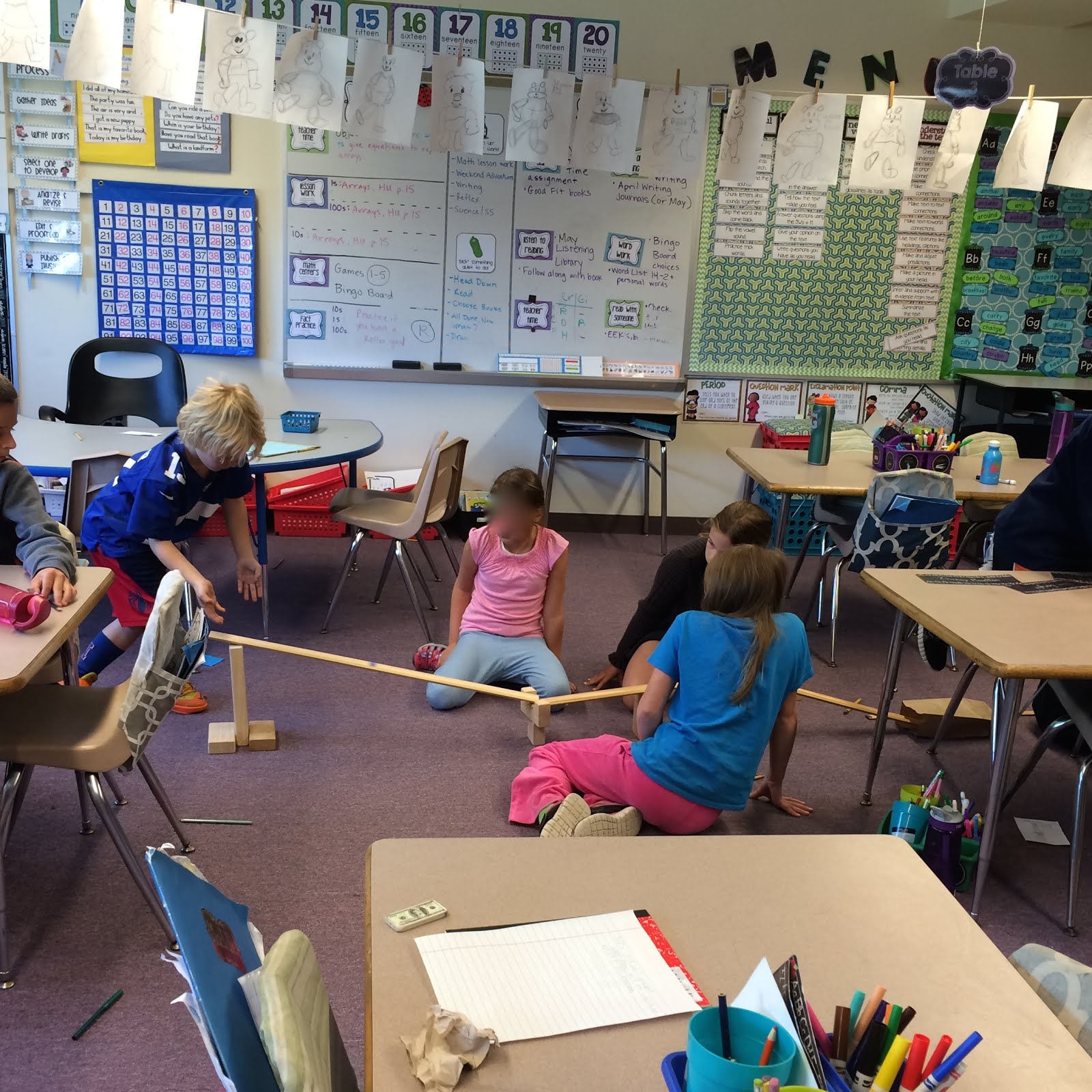
Here are some shots of my kiddos in action this year! We start by building and testing in our small groups...

And then we share our progress and/or success with the group (we get our best ideas from each other, after all!)...


Here are some more complex structures from a later challenge--these have a jump/chasm!


Hope these images give you a sense of how much the kiddos love these materials and challenges, and hope they also inspire you to find a spot for these or other STEM materials in your classroom!

Happy Building!
- Lisa


Signature

STEM in the Classroom and My First GIVEAWAY!


https://www.teacherspayteachers.com/Store/Primary-Explorers


Great news, friends—a sale is on the horizon, literally!

TeachersPayTeachers’ Back to School Sale is tomorrow, and I couldn’t be more excited! I’m writing today to share a bit about STEM in my classroom, but I also wanted to give away $10 to TeachersPayTeachers. My store will be 20% off, and you’ll get another 8% off with the code BESTYEAR. Read through to the bottom to find out about the giveaway!

Getting Started with STEM


While getting ready for the start of school last year, I promised myself that I would incorporate STEM into my classroom. I had heard about it, seen it all over blogs and Pinterest...but I was honestly a bit scared. Math and Science (and obviously, therefore, engineering) have always been outside of my wheelhouse. My go-to beginning-of-year activities, for example, are always book-driven activities and crafts. That’s my comfort zone, but I know it isn’t the case for all my kiddos.

So, I decided to change out some of my book-based activities for STEM challenges. I figured this would be a great way to offer a little something for everyone at a time when most students are feeling a bit insecure, and particularly for my boys who can always use all the movement, building, and hands-on activities I can offer. But even more so, I wanted to give my girls a chance to feel successful in the STEM arena before they caught on to our cultural stereotype that girls aren’t good at math or science.

The other thing I quickly realized was that STEM challenges were an incredible opportunity to get my students working together. We’d always done plenty of group work and partner work, but attempting to solve such an open-ended problem together poses a completely different type of challenge! Kids will naturally disagree, so negotiating those snags to achieve a common end goal is a huge source of growth across the year and a truly commendable accomplishment.


https://www.teacherspayteachers.com/Product/So-You-Wanna-Do-a-STEM-Challenge-2698739

I’ve shared some of my favorite STEM tips and strategies in a packet I just posted on Teachers Pay Teachers. In it, you’ll also find the recording sheets that I use in my class. I typically use one sheet per group (this cuts down on writing time, which certainly has it’s place in STEM challenges, but isn’t the focus here), which is why one version of each the recording sheets has “Names” at the top for multiple group members. I’ve also included versions with and without lines, and simplified forms to ensure these can be used in any grade level, K-4! 


Finally, I’ve included a couple of formats of group roles and the responsibilities for each, as well as a cover in case you want to staple several copies of the recording sheet into a booklet format. I taught an after school STEM class last year, and the booklet format was great for this purpose!

I'll be back tomorrow to share a bit more about my FAVORITE STEM materials and how I use those in the classroom. Until then, please enter the giveaway below to earn a chance to win a $10 Teachers Pay Teachers gift card to spend on some of your back-to-school purchases! 

Happy Shopping!
- Lisa


a Rafflecopter giveaway


Signature
Back to Top